
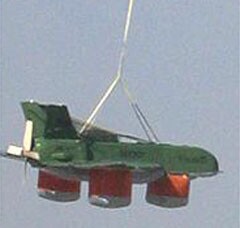
The UAV executing a normal landing with chute and air bags deployed.
|
|
|
|
|
|
|
|
||||||
The UAV executing a normal landing with chute and air bags deployed. |
||||||
Canadian Forces' new unmanned spy plane crashes in Afghanistan
at 9:14 on November 21, 2003, EST.
KABUL (CP) - One of the Canadian army's new unmanned surveillance aircraft came crashing to the ground Friday, temporarily halting the spy plane's testing program.
"We actually don't know what happened," said Lt.-Col. Dana Clarke, director of the unmanned aerial vehicle, or UAV, program. "Observers on the ground saw it when it came in for its normal recovery," said Clarke. "Everything looked normal."
Ground controllers did what they're supposed to do as the aircraft came close to its landing range.
They shut down the plane's 65-horsepower Bombardier snowmobile engine, simultaneously deployed a 117-square-metre parachute and opened a series of air bags to cushion its landing.
However, for reasons yet unknown, the parachute failed to open as the plane descended.
"It carried on for another 652 metres and impacted into the sand on the other side of the hill," said Clarke.
No one was injured when the 3½-metre-long plane crashed into a field.
"Every landing is a hard landing with the air vehicle because it comes down under a chute from about 150 metres," noted Clarke.
"This is the first time we've had a chute failure."
The military has three other identical aircraft - two of which are in use.
However, Friday's crash will delay flight testing of the drones until an investigation is completed.
"It's hard to say how long before we resume flight operations," said Clarke. "I don't expect it will be very long. We have a flight test team here (in Kabul) who will initiate an investigation."
Testing of the equipment used to navigate the vehicle will not be halted.
"We will continue training without the aircraft for awhile. We have simulator capability here," said Clarke, who wasn't sure whether the downed aircraft could be saved.
"This vehicle will be sent away, back to the contractor, and they will repair it or replace it," predicted Clarke.
Manufactured by Orlicon Canada, based in St-Jean, Que., the UAV was being tested by the high-tech arm of the 2,000-member Canadian force in Kabul on behalf of the NATO-led International Security Assistance Force.
The testing program for the $33-million Cdn, high-reconnaissance system, which began Nov. 6, was to have concluded later this month.
Once fully operational, the aircraft will be used to gather video intelligence on suspected terrorist activity around Kabul and in the city's bordering mountains.
Already used by six countries, the spy planes can remain airborne for up to six hours on gasoline, with a range of 180 kilometres or more.
They are launched by catapult from the back of a truck, going from zero to 40 metres per second in 15 metres, capturing video through cameras mounted in a ball on the underside of the aircraft.
There is also a forward-looking, wide-angle camera mounted in the UAV's nose from which ground "pilots" can fly the aircraft by sight.
TERRY PEDWELL
© The Canadian Press, 2003